


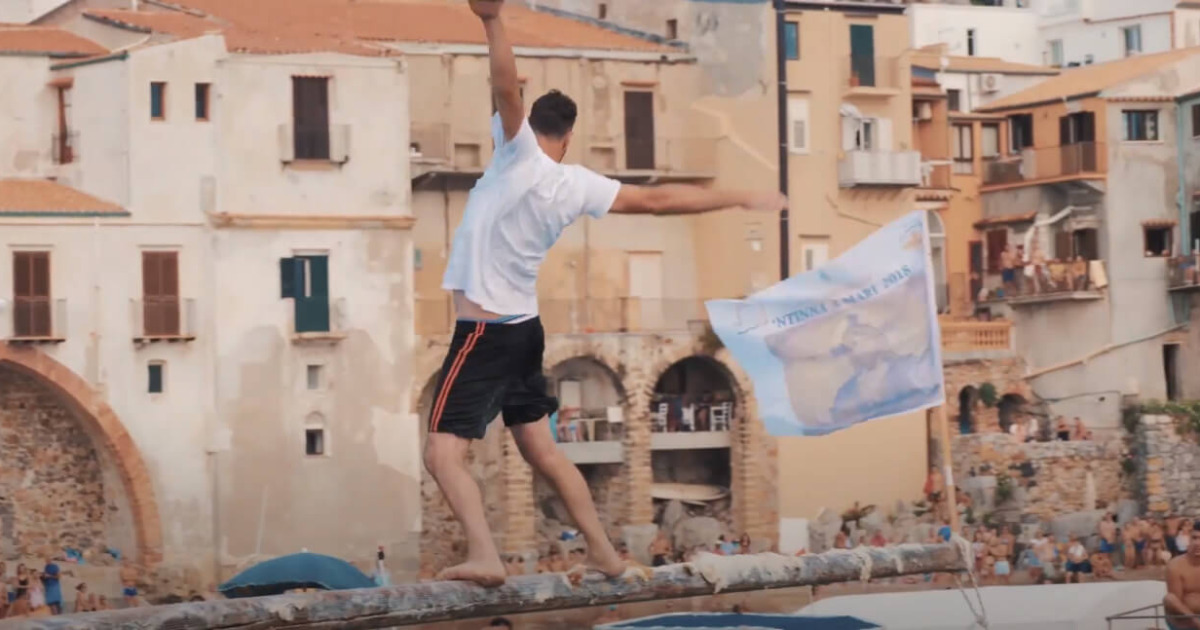
Every year on 6 August, Cefalù’s waterfront becomes the stage for one of Sicily’s oldest and most fascinating traditions: the ‘Ntinna a mari.
This historic competition takes place during the Feast of the Holy Saviour, the patron saint of Cefalù, attracting thousands of locals and visitors every summer. Filled with excitement, spectacular dives and enthusiastic crowds, the ‘Ntinna a mari remains one of the most iconic events in the town’s cultural calendar.
What is the ‘Ntinna a mari?
The ‘Ntinna a mari is a traditional challenge in which participants attempt to reach a flag placed at the end of a long wooden pole suspended over the sea.
The pole, approximately 16 metres long, is covered with grease and soap, making it extremely slippery. Competitors must carefully make their way to the end without falling into the water and successfully grab the flag.
The combination of balance, determination and skill makes the competition both entertaining and incredibly challenging, while spectators gather along the harbour to cheer on the participants.
The origins of the tradition
The exact origins of the ‘Ntinna a mari remain uncertain, and several traditions attempt to explain how it began.
One story suggests that the competition was first organised in 1783 to thank the Holy Saviour for protecting Cefalù from the devastating earthquake that struck much of Sicily.
Another theory links the tradition to ancient sailors, who challenged one another by walking along the bowsprit of their ships before diving into the sea.
Whatever its true origins, the ‘Ntinna a mari has become one of the strongest symbols of Cefalù’s maritime heritage.
How the competition works
The event takes place every year on the Marina Pier (Molo di Piazza Marina).
Before the official competition begins, participants complete several practice runs. The pole is then covered once again with grease and soap before the real challenge starts.
To win, competitors must reach the end of the pole and break the flagpole with their hands without falling into the sea.
Anyone who loses their balance or hangs onto the pole with their arms is immediately eliminated.
Traditionally, many participants come from Cefalù’s historic fishing families, helping to preserve a tradition that has been passed down from generation to generation.
When to watch the ‘Ntinna a mari
The competition takes place every year on 6 August, the final day of the Feast of the Holy Saviour.
It is one of the highlights of the summer in Cefalù and attracts large crowds of spectators. If you want a good viewing spot, it is advisable to arrive well before the competition begins.
Why you should experience it
The ‘Ntinna a mari is much more than a sporting competition.
It is a celebration of Cefalù’s history, traditions and community spirit, offering visitors an authentic glimpse into Sicilian culture.
Watching the competition allows you to experience the town like a local, taking part in a centuries-old tradition that combines faith, folklore and entertainment in a spectacular seaside setting.
Interesting facts
- The ‘Ntinna a mari is a unique tradition held only in Cefalù.
- The wooden pole is coated with grease and soap shortly before the competition begins.
- The event marks the conclusion of the annual Feast of the Holy Saviour.
- Every year it attracts thousands of spectators from across Sicily and from around the world.
Frequently asked questions
When does the ‘Ntinna a mari take place?
Every year on 6 August, during the celebrations of the Feast of the Holy Saviour.
Where is it held?
The competition takes place on the Marina Pier (Molo di Piazza Marina) in the historic centre of Cefalù.
Is it free to watch?
Yes. The event is free and open to everyone.
How long does the competition last?
The duration varies depending on the number of participants and the progress of the competition, but it generally lasts a few hours.